
The Architecture of Virality: A Creator’s Field Notes from the Attention Economy
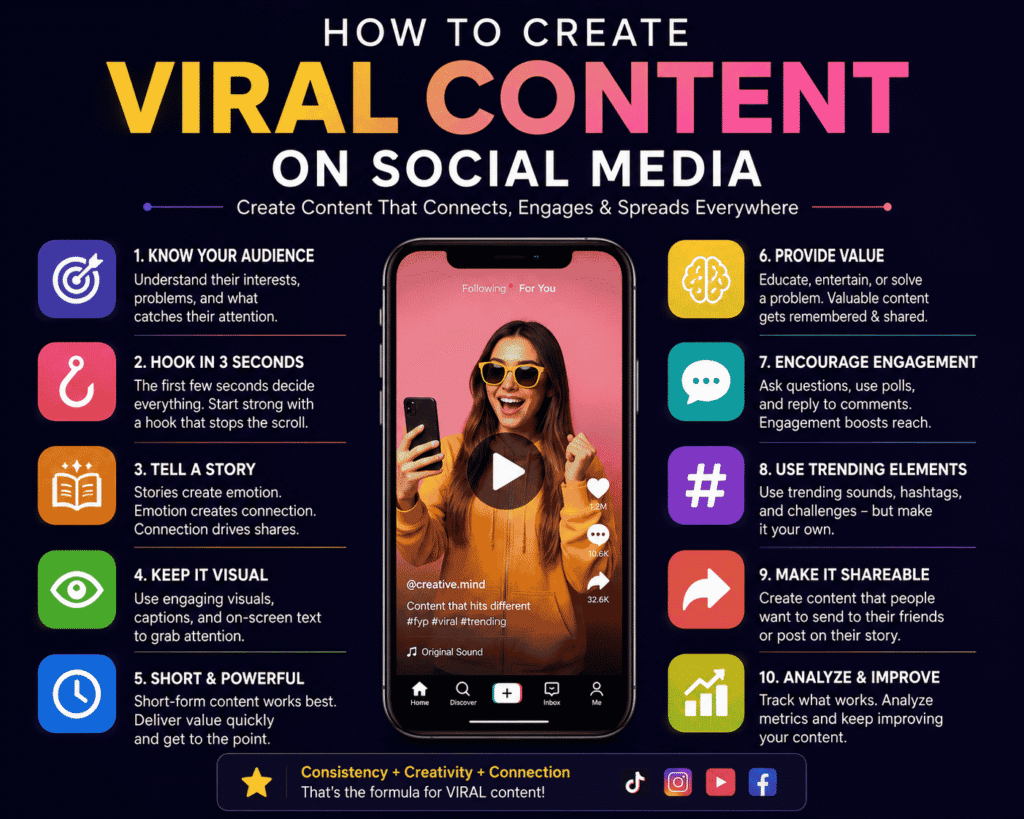
There is a strange silence that follows every post before it is seen.
Not the silence of absence—but the silence of uncertainty.
A creator hits “publish,” and for a brief moment, the internet feels like a vast, indifferent machine. No applause, no rejection—only waiting. And in that waiting, something interesting begins to unfold: content is no longer content. It becomes a hypothesis.
Will it move people? Or disappear without friction?
Virality, in its most honest form, is not a spark of luck. It is a sequence of psychological collisions carefully aligned with human behavior.
The Moment Attention Breaks Its Routine
Every scroll is a habit loop. A thumb moves before thought arrives. This is the environment in which content must survive.
To earn attention, a piece of content must disrupt routine without asking permission.
Not loudly. Not aggressively. But precisely.
The most effective content does not announce itself—it interrupts familiarity. A pattern feels slightly off. A sentence begins in a way the mind did not expect. A visual creates cognitive hesitation.
And in that fraction of hesitation, attention is borrowed.
That borrowed attention is the beginning of everything.
The Illusion of “Going Viral”
Most creators imagine virality as an outcome.
In reality, it behaves more like a chain reaction with emotional ignition points.
A viewer does not share content because it is “good.”
They share it because it performs a function inside them:
- It expresses something they cannot articulate
- It validates something they already believe
- It challenges something they are unsure about
- Or it makes them feel momentarily seen
Content becomes viral when it stops being personal property of the creator and starts functioning as emotional currency for the viewer. At that moment, ownership shifts.
Hooks Are Not Openings—They Are Disturbances
A common misunderstanding among creators is that a hook is an introduction.
It is not.
A hook is a controlled disturbance in attention flow.
It creates unfinished thought. A sentence that refuses to complete itself. A claim that demands resolution. A contradiction that feels unresolved.
The brain, uncomfortable with incompleteness, leans forward automatically.
That leaning forward is more valuable than any editing effect, camera angle, or background music.
Because once attention leans, it is already inside the content.
Storytelling as the Hidden Operating System
Information informs. But stories pull.
A story does not behave like data—it behaves like experience compressed into time.
Even in short-form content, narrative structure persists like an invisible spine:
a situation forms, tension builds, and meaning resolves.
The viewer may not consciously notice it, but their attention obeys it.
This is why the same idea can fail as a statement and succeed as a story.
One is consumed. The other is lived, even briefly.
The Algorithm Does Not Reward Creativity—It Reflects Behavior
There is a tendency to treat algorithms as mysterious forces.
They are not.
They are reflection systems built on one principle: sustained attention equals value.
If people stop watching, the system assumes irrelevance.
If they replay, pause, or share, the system assumes importance.
There is no emotion in this logic—only behavior tracking.
The uncomfortable truth is that the algorithm is rarely the problem. The content either holds attention or it does not.
Everything else is interpretation.
Rhythm: The Invisible Craft Most Creators Ignore
Beyond ideas and visuals, there is rhythm.
Not musical rhythm—but cognitive rhythm.
A piece of content breathes through:
- acceleration
- pause
- interruption
- release
When everything is intense, nothing registers as intense. When everything is fast, nothing feels important.
Control of rhythm is control of perception.
It determines whether attention stays passive or becomes engaged.
Why People Share: The Social Function of Content
Sharing is not a technical action. It is a social decision.
People share content when it does one of three things:
- It enhances their identity
- It communicates something on their behalf
- It creates social alignment or disagreement
In other words, content spreads when it becomes useful beyond itself.
A viewer is not thinking, “this is viral.”
They are thinking, “this represents something I want to express.”
That is the real transmission point.
Consistency Is Not Repetition—It Is Recognition
Posting frequently does not create authority.
Recognition does.
Recognition forms when the audience begins to associate a specific emotional or intellectual space with a creator. Not a topic alone, but a tone, a perspective, a pattern of thinking.
When that happens, content no longer needs to be rediscovered each time. It is anticipated.
And anticipation is one of the strongest drivers of sustained engagement.
The Art and Strategy of Social Media Marketing
Social media marketing is not simply the act of posting content regularly, but the strategic process of designing attention, shaping perception, and guiding audience behavior in a highly competitive digital environment. Every platform operates as an attention ecosystem where users scroll rapidly, making instant decisions about what deserves their focus and what should be ignored. In this environment, successful marketing begins with deep audience understanding—identifying not only demographics, but also emotions, interests, frustrations, aspirations, and the psychological triggers that influence engagement. Once this foundation is established, content must be built with intention, where every post serves a purpose within a larger narrative system rather than existing as an isolated piece of media.
The first layer of effective social media marketing is attention capture. This is achieved through strong hooks, visual disruption, and message framing that interrupts habitual scrolling patterns. However, attention alone is not enough; it must be sustained through clarity, relevance, and emotional continuity. This is where storytelling becomes essential. Instead of presenting information as disconnected ideas, brands must communicate through structured narratives that create curiosity, tension, and resolution, allowing the audience to feel part of an unfolding experience rather than a passive viewer.
The second layer is engagement design. Engagement does not happen by chance—it is engineered through content that encourages reaction, reflection, or identification. This includes content that validates audience beliefs, introduces new perspectives, or emotionally resonates with personal experiences. When users feel seen or understood, they naturally interact, share, and return. At this stage, consistency plays a critical role, not as repetition, but as recognition. A consistent tone, message style, and visual identity allow audiences to form familiarity, which gradually builds trust and authority.
The third layer is algorithmic alignment. Social media platforms reward content based on behavioral signals such as watch time, shares, saves, and replays. Therefore, effective marketing must align creative output with these signals by optimizing rhythm, pacing, and structure. A well-designed piece of content alternates between acceleration and pause, information and suspense, ensuring that attention is continuously renewed rather than lost. This transforms content from a static message into a dynamic experience that holds user focus for longer durations.
Finally, social media marketing evolves into conversion and community building. At this stage, the goal shifts from attracting attention to transforming it into meaningful relationships. Audiences are guided from passive viewers into active followers, and eventually into a community that identifies with the brand’s voice and values. This transformation happens when content consistently delivers value, reinforces identity, and builds emotional connection over time.
In essence, modern social media marketing is a structured system where psychology, storytelling, design, and analytics converge. It is not about chasing virality randomly, but about constructing a repeatable framework that understands human behavior and leverages it ethically and strategically. When executed with precision, it turns attention into influence, and influence into sustainable digital growth.
Final Observation: Virality Is Not Chased, It Is Designed
The pursuit of virality often misleads creators into thinking they must chase trends, mimic formats, or force engagement.
But the deeper reality is quieter.
Virality happens when content aligns with how humans already think, feel, and share—without resistance.
It is not about volume.
It is about precision of impact.
The creator’s real task is not to shout louder into the feed, but to construct moments that the mind cannot scroll past without consequence.
Because in the attention economy, silence is not emptiness.
It is opportunity.
And what fills that opportunity determines whether content disappears—or travels further than its origin ever intended.