
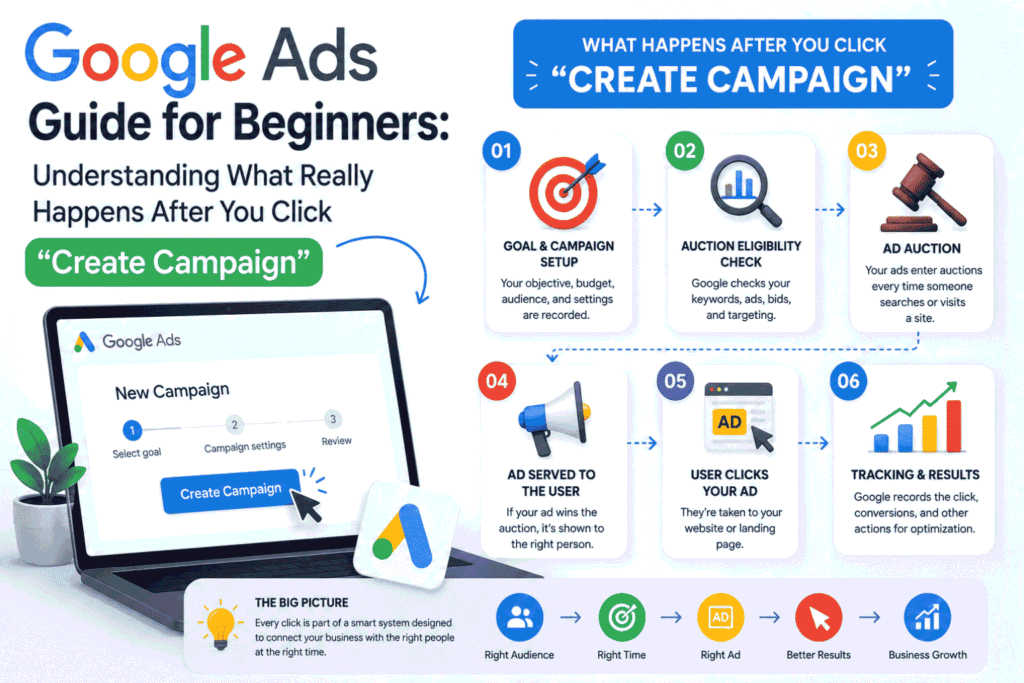
The first time I opened Google Ads, I expected it to be straightforward.
After all, the concept sounded simple enough.
Create an advertisement, choose a budget, publish it, and wait for visitors to arrive.
Within a few minutes, I realized I had underestimated the platform.
There were campaign types, bidding strategies, audience settings, conversion tracking, keyword options, quality scores, and dozens of decisions that seemed important.
For beginners, Google Ads can feel less like a marketing tool and more like the cockpit of an airplane.
The challenge isn’t learning where the buttons are.
The challenge is understanding why those buttons exist in the first place.
Many new advertisers lose money because they focus on the mechanics of creating ads without understanding the system that determines which ads appear, when they appear, and why some campaigns succeed while others struggle.
This is one of the reasons why Performance Marketing requires both technical knowledge and strategic thinking.
Before discussing budgets, keywords, or bidding strategies, it helps to understand a simple reality:
Google Ads is not primarily an advertising platform.
It is a problem-solving platform.
People come to Google because they need answers, products, services, or information.
Advertisements are simply one of the ways Google connects those people with potential solutions.
The advertisers who understand this principle often make better decisions from the very beginning and build stronger Performance Marketing campaigns.
Why Google Ads Exists
Imagine someone searching for a plumber after discovering a leaking pipe.
Another person searches for running shoes.
Someone else searches for accounting software for a growing business.
Behind every search is a specific intention.
Google’s job is to provide the most relevant results.
Google Ads allows businesses to place their solutions in front of people at the exact moment they are looking for something related.
This timing is what makes the platform powerful and one of the most effective channels in Performance Marketing.
Unlike traditional advertising, where businesses often interrupt people who are not actively searching, Google Ads places businesses in front of users who already have a purpose.
That difference changes everything.
The Biggest Misunderstanding Beginners Have
Many first-time advertisers assume Google Ads works like an auction where the highest bidder always wins.
If that were true, large companies could dominate every search result simply by spending more money.
In reality, Google’s advertising system is much more sophisticated.
The platform evaluates factors such as:
- Ad relevance
- Expected user experience
- Landing page quality
- Historical performance
- Bid amount
This means a smaller business with a highly relevant advertisement can sometimes outperform a larger competitor spending significantly more money.
Understanding this concept early can save beginners from one of the most common mistakes: assuming higher spending automatically produces better results in Google Ads and Performance Marketing.
Before Spending Money, Understand Your Goal
A surprising number of businesses launch campaigns without defining success.
They simply want “more traffic.”
Traffic sounds useful until you realize not all visitors are valuable.
Suppose two campaigns each generate one thousand visitors.
The first campaign produces fifty qualified leads.
The second campaign produces zero sales inquiries.
Both campaigns generated traffic, but only one created meaningful business value.
This is why goals matter, especially in Performance Marketing, where every click and conversion should contribute to measurable business growth.
Before creating a campaign, ask:
- Do I want phone calls?
- Do I want online purchases?
- Do I want leads?
- Do I want newsletter signups?
- Do I want brand awareness?
The answer influences every decision that follows.
Keywords Are Conversations
Most beginners view keywords as technical settings.
A more useful perspective is to see them as conversations.
When someone searches for “best laptop for students,” they are having a different conversation than someone searching for “buy gaming laptop today.”
The first person is researching.
The second person may be closer to making a purchase.
Google Ads becomes more effective when advertisers understand the intent behind searches instead of focusing only on the words themselves.
Successful Performance Marketing campaigns often begin by understanding what users are trying to accomplish rather than simply collecting keyword lists.
Your Advertisement Is a Promise
One lesson becomes obvious after reviewing hundreds of online advertisements.
Many ads attempt to attract attention.
Fewer ads focus on building trust.
An effective advertisement makes a clear promise.
It tells users what they can expect after clicking.
Problems arise when advertisements promise one thing while landing pages deliver something entirely different.
Imagine clicking an advertisement offering expert advice only to arrive on a page filled with aggressive sales messages.
The disconnect creates frustration.
Google notices these experiences.
Users notice them even more.
The strongest Google Ads campaigns maintain consistency between the search, the advertisement, and the landing page.
The Landing Page Matters More Than Most Beginners Realize
Many advertisers spend hours refining advertisements while giving little attention to where visitors arrive after clicking.
This is often a costly mistake.
The advertisement’s job is not to make a sale.
Its job is to earn a click.
The landing page must complete the process.
A visitor should immediately understand:
- Where they are
- What is being offered
- Why it matters
- What action to take next
Confusing layouts, slow loading speeds, and unclear messaging can reduce performance even when the advertisement itself is excellent.
In many cases, improving the landing page produces better results than increasing advertising budgets, which is a core principle of successful Performance Marketing.
Why Tracking Changes Everything
Imagine running advertisements without knowing which ones generate results.
Unfortunately, many beginners do exactly that.
Without proper tracking, advertising becomes guesswork.
You may know visitors are arriving, but you won’t know which campaigns, keywords, or advertisements are creating meaningful outcomes.
Tracking transforms marketing from assumption into evidence.
Instead of asking:
“Do I think this campaign is working?”
You can ask:
“What does the data show?”
That distinction often separates successful advertisers from struggling ones in both Google Ads and Performance Marketing.
Patience Is an Underrated Skill
One of the most common beginner mistakes is making major changes too quickly.
A campaign runs for a few days.
Results appear slower than expected.
Settings are changed repeatedly.
Budgets are adjusted.
Keywords are removed.
New advertisements are added.
Soon it becomes impossible to determine what is helping and what is hurting performance.
Google Ads often requires time to collect meaningful data.
Patience allows patterns to emerge.
Without patience, optimization becomes reaction rather than strategy, which can negatively affect long-term Performance Marketing results.
Budget Does Not Guarantee Success
Many newcomers believe larger budgets solve advertising problems.
In reality, budget amplifies strategy.
A well-structured campaign with a modest budget can outperform a poorly managed campaign spending significantly more.
Advertising success is rarely determined by spending alone.
It is determined by how effectively spending aligns with user intent, business goals, and customer needs.
The goal is not to spend more.
The goal is to spend smarter in your Google Ads campaigns and broader Performance Marketing efforts.
Learning Never Stops
One reason Google Ads remains effective is that user behavior continuously evolves.
Search habits change.
Competition changes.
Technology changes.
Even experienced advertisers continue testing, learning, and adapting.
Beginners should view their first campaigns as learning opportunities rather than final exams.
Every campaign provides insights.
Every result reveals something about customer behavior.
Every improvement builds a stronger foundation for future success in Performance Marketing.
Final Thoughts
The most important lesson beginners can learn about Google Ads is that advertising is not about convincing people to click.
It is about helping the right people find the right solution at the right moment.
The platform provides powerful tools, but tools alone do not create results.
Success comes from understanding user intent, building trust, measuring outcomes, and continuously improving the experience you provide.
Google Ads can generate traffic, leads, sales, and visibility.
However, the businesses that achieve long-term success are usually the ones that focus less on advertisements themselves and more on the people behind the searches.
When you understand those people, every campaign decision becomes clearer.
And that understanding is often more valuable than any advertising tactic you will ever learn in Google Ads or Performance Marketing.