
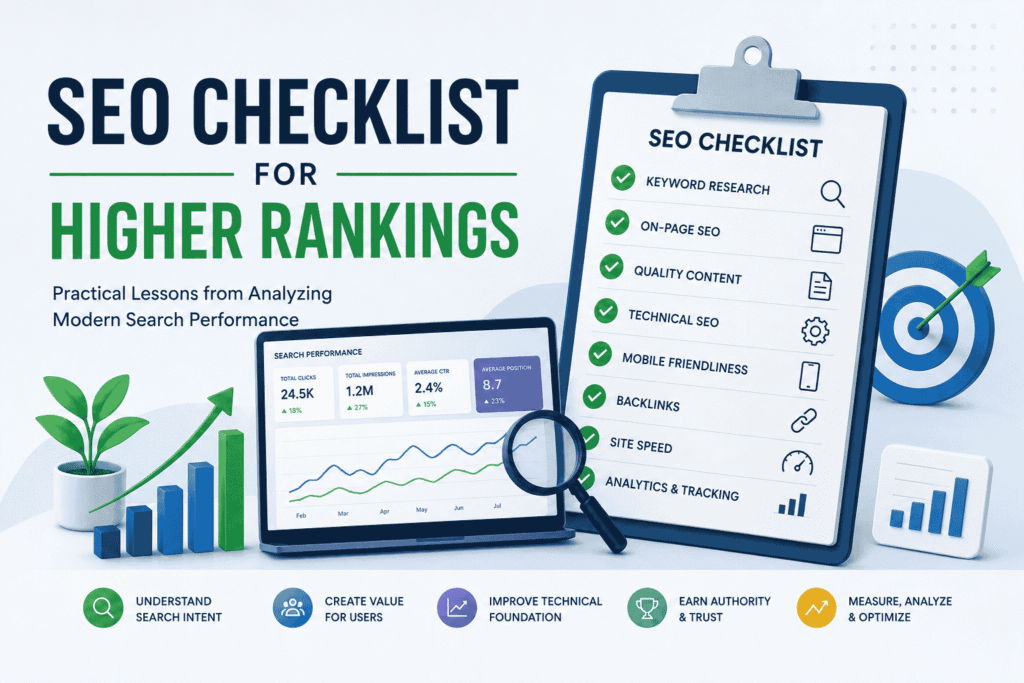
Search engine optimization has changed dramatically over the last few years.
When I first started studying how websites perform in search results, many SEO discussions revolved around keywords, backlinks, and technical adjustments. While those factors still matter, one thing became increasingly clear after reviewing websites across different industries: pages that consistently rank well are usually built around user value, not search engine tricks.
Google’s search systems have evolved to better understand content quality, relevance, expertise, and user satisfaction. As a result, websites that focus on helping their audience often outperform websites that focus only on ranking tactics.
This SEO checklist is based on the patterns commonly found among pages that continue to perform well despite algorithm updates and increasing competition.
Start with User Intent Before Anything Else
Before choosing keywords or planning content, ask a simple question:
What is the user actually trying to accomplish?
Many websites begin their SEO strategy with keyword research. Successful websites begin with understanding the audience.
For example, someone searching for an “SEO checklist” is rarely looking for definitions. They typically want a practical framework that helps them improve their website’s visibility.
When content aligns with the real purpose behind a search query, it becomes easier to satisfy both users and search engines.
Understanding search intent should be the foundation of every SEO strategy.
Use Keywords as Guidance, Not the Entire Strategy
Keywords remain important because they reveal how people search for information online.
However, modern SEO is no longer about repeating the same phrase throughout a page.
Instead, effective content naturally covers a topic in depth, answers related questions, and provides useful information that supports the user’s goal.
When a page thoroughly addresses a subject, relevant keywords and related terms often appear naturally throughout the content.
Search engines have become increasingly capable of understanding context, relationships between topics, and overall content relevance.
The focus should always be on providing meaningful answers rather than forcing keywords into every section.
Create Titles That Encourage Clicks
Even the most valuable content can struggle if nobody clicks on it.
Your page title is often the first interaction users have with your content in search results.
An effective title should:
- Clearly explain the topic.
- Communicate a benefit.
- Match search intent.
- Encourage curiosity without being misleading.
For example, a title that promises actionable steps often performs better than a vague or overly creative headline.
Users want to know exactly what value they will receive before they click.
Focus on Content Depth and Usefulness
One observation consistently appears when analyzing high-performing content:
Comprehensive pages tend to outperform shallow content.
This does not mean every article must be extremely long. Instead, it means readers should leave with fewer unanswered questions than they had before arriving.
Useful content typically:
- Solves a specific problem.
- Explains concepts clearly.
- Provides actionable recommendations.
- Anticipates follow-up questions.
- Includes examples when appropriate.
Content quality is ultimately measured by how helpful readers find it.
Demonstrate Experience and Expertise
Google’s E-E-A-T framework emphasizes the importance of experience and expertise.
Readers are more likely to trust information when they understand where it comes from and why the author is qualified to discuss the topic.
Ways to strengthen credibility include:
- Sharing real-world observations.
- Explaining practical experiences.
- Referencing reliable sources.
- Updating outdated information.
- Providing accurate and transparent guidance.
When users trust the information on a website, search engines gain stronger signals that the content is valuable.
Improve Website Structure and Internal Linking
Website organization plays a significant role in both usability and SEO.
Think of your website as a network of connected topics.
If a visitor reads an article about technical SEO, they should easily discover related resources such as keyword research, content optimization, or site audits.
Effective internal linking helps:
- Users find additional information.
- Search engines understand content relationships.
- Important pages receive more visibility.
- Topic authority develops across the website.
A well-structured website creates a better experience for everyone.
Prioritize Page Speed and Performance
Website speed directly affects user experience.
When pages load slowly, visitors are more likely to leave before engaging with the content.
Fast websites help users:
- Access information quickly.
- Navigate more smoothly.
- Complete actions with less frustration.
Performance improvements such as image optimization, efficient code, and reliable hosting can contribute to a better overall experience.
Page speed is no longer just a technical consideration—it is an essential part of user satisfaction.
Ensure a Strong Mobile Experience
Most online searches now occur on mobile devices.
A website that functions perfectly on desktop but struggles on smartphones creates unnecessary obstacles for visitors.
A mobile-friendly website should offer:
- Readable text without zooming.
- Easy-to-tap buttons.
- Responsive layouts.
- Fast loading times.
- Simple navigation.
Designing with mobile users in mind helps improve engagement and accessibility across all devices.
Build Quality Backlinks Through Value
Backlinks continue to be an important ranking signal, but quality matters far more than quantity.
A single link from a respected industry publication can often provide more value than dozens of links from unrelated or low-quality websites.
The most sustainable approach to earning backlinks includes:
- Publishing original research.
- Creating useful resources.
- Producing insightful content.
- Building relationships within your industry.
High-quality backlinks are typically earned because people find the content worth recommending.
Monitor, Update, and Improve Existing Content
SEO is not a one-time project.
Search behavior changes, competitors publish new content, and industry information evolves over time.
Regularly reviewing existing content can help identify opportunities to:
- Improve accuracy.
- Add new information.
- Enhance readability.
- Update examples.
- Address emerging search trends.
Many websites achieve stronger rankings by improving existing pages rather than constantly creating new ones.
Final Thoughts
After analyzing countless websites and observing how search performance evolves, one principle remains consistent:
Successful SEO is rarely the result of a single tactic.
Higher rankings are often the outcome of many small improvements that collectively create a better experience for users.
When your website focuses on solving problems, demonstrating expertise, building trust, and delivering valuable information, SEO becomes a natural byproduct of quality rather than a pursuit of shortcuts.
Search algorithms will continue to evolve, but the goal remains the same: provide content that genuinely helps people.
Websites that consistently prioritize user value are often the ones that earn sustainable visibility in search results over the long term.